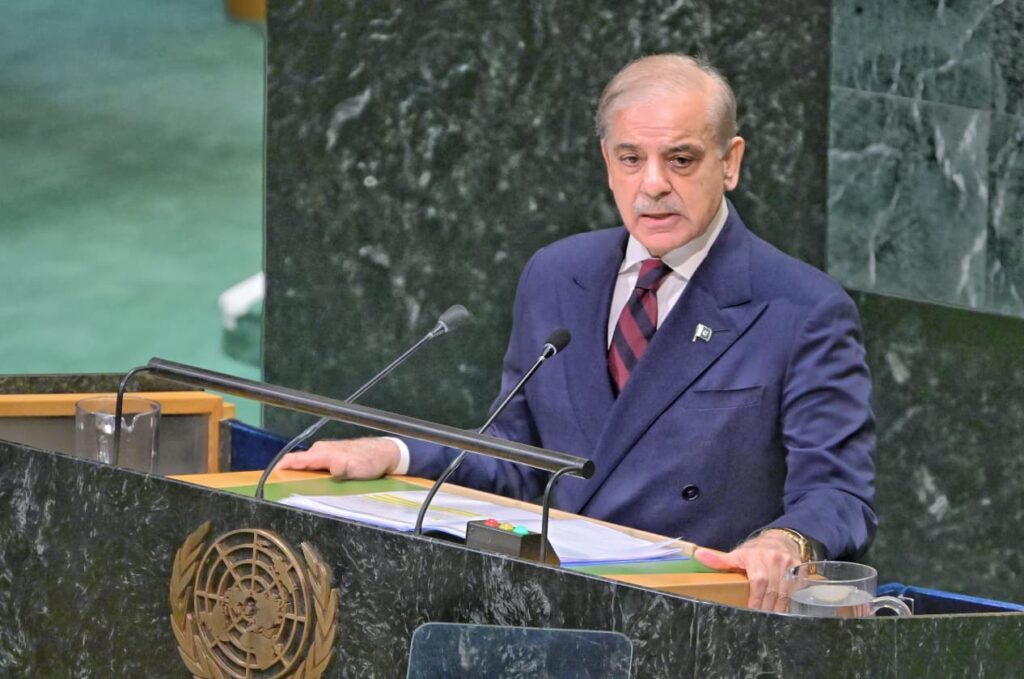
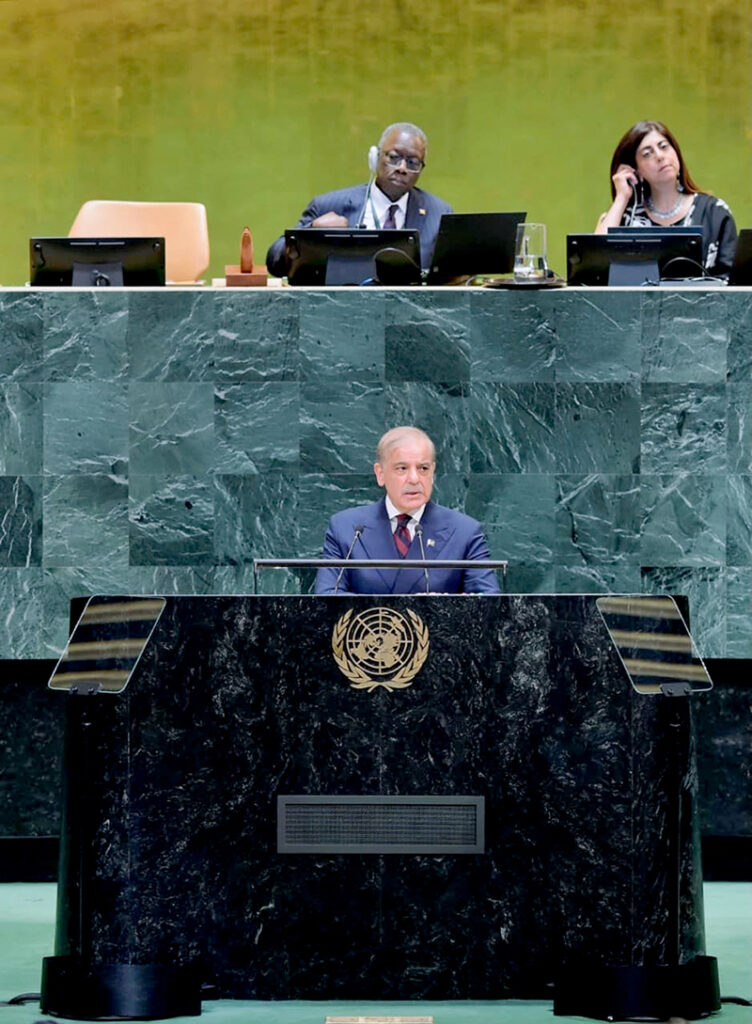
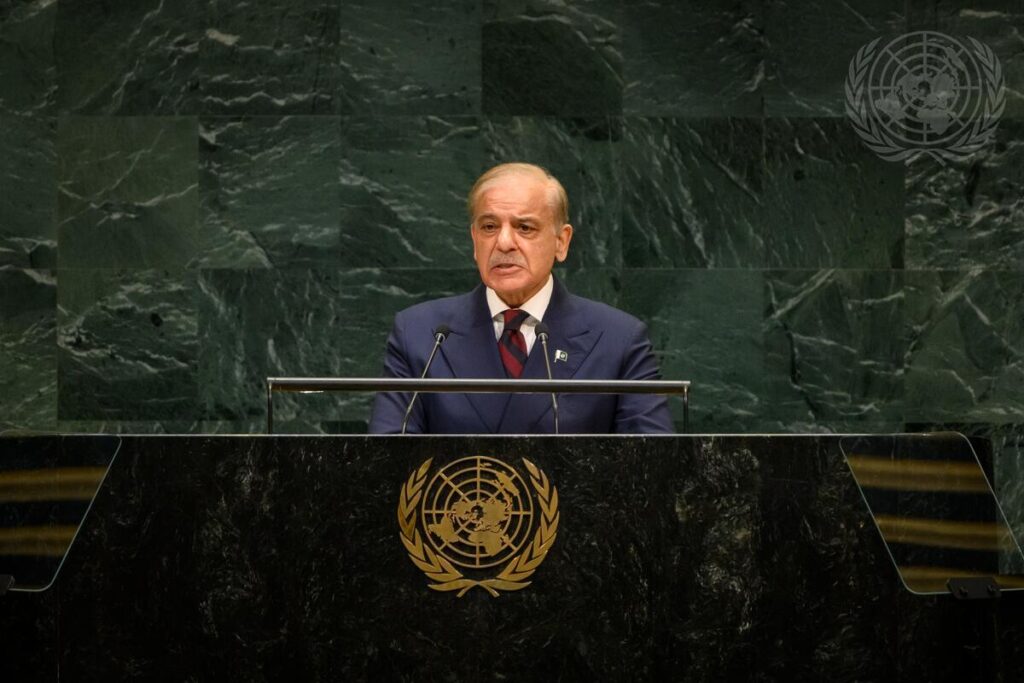
UNITED NATIONS, Sept 25 (APP): Prime Minister Muhammad Shehbaz Sharif has called for renewed diplomatic efforts to end escalating hostilities in the Middle East, urging the international community to give dialogue and peace a chance while ensuring that vital maritime routes remain open for global trade and economic activity.
Addressing the 81st session of the United Nations General Assembly in New York, the prime minister described the Strait of Hormuz and Bab-al-Mandeb as critical arteries of the global economy. He stressed that these strategic waterways should serve connectivity, trade and prosperity rather than become flashpoints for confrontation.
Recalling Pakistan’s diplomatic efforts during the Gulf and wider Middle East conflict in February, Shehbaz said Islamabad had worked to bring Washington and Tehran closer to the negotiating table. He described the Islamabad Talks and subsequent Islamabad Memorandum of Understanding as significant steps towards ending the conflict.
He also acknowledged the contributions of Deputy Prime Minister and Foreign Minister Ishaq Dar and Field Marshal Syed Asim Munir in creating space for diplomacy during difficult circumstances.
The prime minister expressed deep concern over the renewed escalation of violence and called for diplomacy to prevail over military confrontation. He strongly condemned Israel’s actions against Palestinians and voiced concern over the expansion of violence into the West Bank.
Shehbaz reiterated Pakistan’s position that a durable settlement requires the establishment of an independent, sovereign, viable and contiguous Palestinian state based on the pre-1967 borders, with Al-Quds Al-Sharif as its capital. He also called for an immediate end to Israeli aggression against Lebanon and Syria.
Turning to the Kashmir dispute, the prime minister reaffirmed Pakistan’s continued diplomatic, political and moral support for the Kashmiri people and their right to self-determination. He recalled Pakistan’s confrontation with India and said Islamabad had exercised its right to self-defence under Article 51 of the UN Charter.
He credited diplomatic intervention, including that of US President Donald Trump, with helping prevent a wider conflict between the two nuclear-armed South Asian neighbours. Shehbaz stressed that lasting regional stability required a just and fair resolution of the Kashmir dispute.
He also raised concerns over the Indus Waters Treaty, saying the shared river system was vital for the people of Pakistan and the wider region. He maintained that water should not be used as a political or strategic weapon and urged that rivers should serve as a source of cooperation rather than division.
On global development, Shehbaz called for timely debt relief, affordable long-term financing and greater representation for developing countries in international financial institutions. He noted that Pakistan contributes less than one per cent of global emissions while remaining highly vulnerable to climate change, urging developed countries to fulfil their climate-finance commitments and provide support for adaptation and resilience.
The prime minister highlighted Pakistan’s economic reform agenda, saying structural reforms and fiscal discipline had helped restore macroeconomic stability. He said the government was focusing on agriculture, industry, mineral development, digitalisation and equipping young people with artificial intelligence and information technology skills.
He also highlighted expanding economic opportunities through the China-Pakistan Economic Corridor, as well as stronger links with the Gulf, Central Asia and other regions.
On regional security, Shehbaz said the Makkah Joint Defence Agreement among Saudi Arabia, Türkiye and Pakistan was not directed against any country but reflected a shared commitment to defence, stability and peace. He strongly condemned attacks against Saudi Arabia and said any threat to the safety and sanctity of the Haramain Sharifain was unacceptable.
Concluding his message, the prime minister emphasised Pakistan’s preference for dialogue, cooperation and peace over confrontation and war, calling for collective international efforts to build a more stable and prosperous future.

 American Chamber of Commerce Qatar
 Bangladeshi Community
 Filipino Community
 Indian Community
 Nepali Community
 Pakistani Community
 Sri Lankan Community